Kings and Queens
Discover the stories of the Monarchs

Kings and Queens in Politics
Choose your Monarch

From Celtic to Modern Times
The great and not so great RULERS
Discover the stories of the Monarchs
Choose your Monarch
The great and not so great RULERS
If you have a suggestion regarding additional topics you would like to see included - please let us know
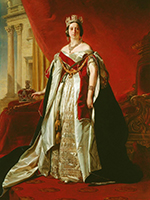
 Queen Victoria of England, born Alexandrina Victoria on May 24, 1819, was one of the most iconic monarchs in British history. She was the daughter of Prince Edward, Duke of Kent and Strathearn, the fourth son of King George III, and Princess Victoria of Saxe-Coburg-Saalfeld. Victoria's early life was dominated by the influence of her mother and Sir John Conroy, her mother's close adviser, in what was known as the "Kensington System," a series of strict rules and protocols meant to control Victoria and keep her isolated.
Victoria ascended to the throne in 1837 at the age of 18 after the death of her uncle, King William IV. Her reign, which spanned from 1837 to 1901, is now known as the Victorian Era, a period marked by vast changes in British society, politics, and the empire. The Industrial Revolution reached its zenith under her rule, transforming the UK into the world's foremost global power.
During her reign, Queen Victoria faced numerous challenges. Early in her reign, she navigated the intricacies of the monarchy's relationship with Parliament, especially during the era of Prime Minister Lord Melbourne, who became her trusted adviser. Victoria played a more active role in politics than many of her predecessors, showing favoritism to certain politicians, which occasionally caused public and parliamentary consternation. She had a particularly strained relationship with William Gladstone, whom she referred to as a "half-mad monarchist."
Victoria's reign witnessed the vast expansion of the British Empire, with territories in Africa, Asia, and the Pacific being added to the crown. This expansion led to the popular saying, "The sun never sets on the British Empire." The empire brought both prosperity and challenges, including conflicts like the Boer Wars and the Indian Rebellion of 1857, which caused a shift in the governance of India from the East India Company to the Crown.
The Queen held traditional views, embodying moral rectitude and family values, which reflected in the general Victorian society. This period was characterized by strict societal norms, industrial growth, urbanization, and the expansion of the middle class. Culturally, it was a golden age for literature with authors like Charles Dickens, George Eliot, and Thomas Hardy writing some of their most celebrated works.
Queen Victoria's personal life was deeply intertwined with her political one. In 1840, she married her first cousin, Prince Albert of Saxe-Coburg and Gotha. Their relationship was a genuine love match, and together they had nine children, who eventually married into various European royal families. Victoria deeply mourned Albert's premature death in 1861 and wore black for the remainder of her life in his honor.
Towards the end of the 19th century, as monarchies across Europe faced challenges, Queen Victoria became the emblem of stability and continuity. Her relationship with her subjects underwent transformation after the death of Prince Albert, from one of distance to one of revered matriarch of the nation.
Victoria's death on January 22, 1901, marked the end of an era. Her passing was deeply mourned throughout the British Empire. The British people, many of whom had known no other monarch, felt a deep sense of loss. She was succeeded by her eldest son, who became King Edward VII, ushering in the Edwardian era.
The Victorian era, thanks to its namesake queen, left an indelible mark on British culture, politics, and society. It was an age of contrasts, with incredible progress and expansion but also marked by societal inequalities and imperial challenges.
Reference: Article by Greg Scott (Staff Historian), 2024